
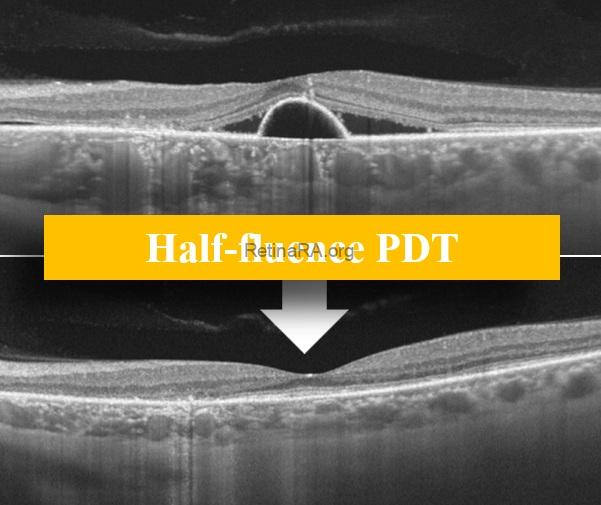
In the third lecture of our Pachychoroid Spectrum series, Prof. Dr. Giray Ersöz focuses on the treatment of Central Serous Chorioretinopathy (CSC), with particular emphasis on evidence-based treatment strategies and practical clinical decision-making.
The lecture begins by reviewing the treatments that are generally not recommended in CSC, including topical and oral carbonic anhydrase inhibitors, topical nonsteroidal anti-inflammatory drugs, and anti-VEGF therapy in the absence of macular neovascularization. The available evidence for different treatment modalities is then discussed, highlighting the evolution of CSC management and the role of observation, laser treatment, mineralocorticoid receptor antagonists, and photodynamic therapy.
Particular attention is given to reduced-setting photodynamic therapy (PDT), which is presented as the current standard treatment for chronic or complex CSC. Half-dose, half-fluence, and half-time protocols are reviewed, with a practical focus on half-fluence PDT. Evidence from major clinical trials, including the PLACE, REPLACE, SPECTRA, and VICI studies, is discussed to compare PDT with subthreshold laser and eplerenone. The lecture also addresses the effects of PDT beyond fluid resolution, including its impact on pigment epithelial detachments, choroidal thickness, choroidal remodeling, recurrence rates, and retinal sensitivity.
The role of subthreshold laser treatment is also discussed from a practical perspective. Treatment indications, laser parameters, leakage patterns, the importance of maintaining a safe distance from the fovea, and situations in which subthreshold laser should be avoided are reviewed. The lecture also emphasizes that subthreshold laser does not appear to reduce recurrence rates and discusses the potential retinal damage associated with repeated or excessive laser applications.
Finally, the lecture addresses the management of macular neovascularization associated with CSC. The distinction between silent and active macular neovascularization is explained, together with a practical treatment strategy. Silent lesions are approached primarily with reduced-setting PDT and a single anti-VEGF injection as a protective measure, followed by injection-free monitoring. In active macular neovascularization, anti-VEGF therapy is combined with PDT, followed by a rapid treat-and-extend strategy. The potential for patients with CSC-associated macular neovascularization to become free from long-term anti-VEGF injections after combined treatment is also discussed.
Credit: M. Giray Ersoz, MD, FEBO, Retina Specialist
Memorial Bahçelievler Hospital, Department of Ophthalmology, Istanbul, Turkey
Arel University School of Medicine, Department of Ophthalmology, Istanbul, Turkey
Instagram accounts: @retina.review and @retina.dr.girayersoz
Website: www.girayersoz.com.tr
