
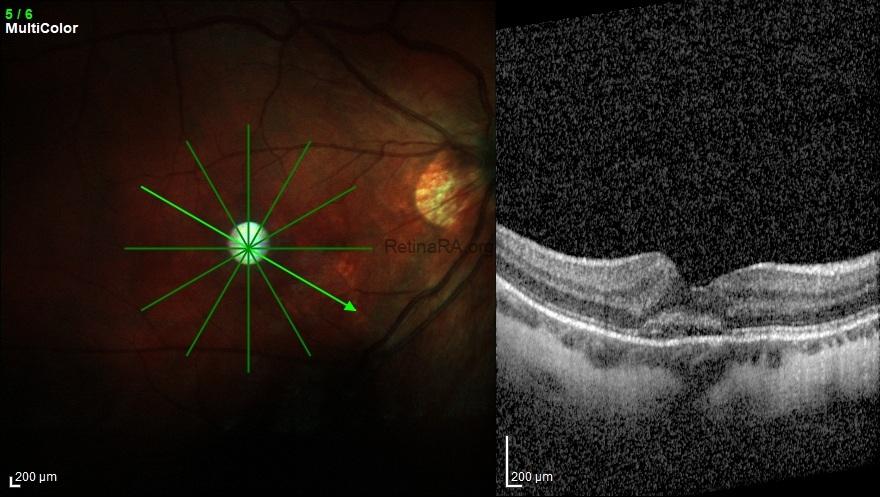
A 30-year-old woman presented with decreased vision and blurred central vision in her right eye. Best-corrected visual acuity was 0.5 in the right eye and 0.7 in the left eye. Intraocular pressures were within normal limits. Anterior segment examination revealed bilateral phakic intraocular lenses and peripheral iridectomies, consistent with previous refractive surgery for high myopia.

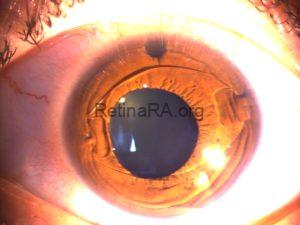
Dilated fundus examination demonstrated bilateral myopic fundus changes, including a prominent tessellated fundus appearance, peripapillary chorioretinal atrophy, myopic peripapillary crescents, and increased visibility of the underlying choroidal vasculature. In the right eye, a small macular hemorrhage was also observed.

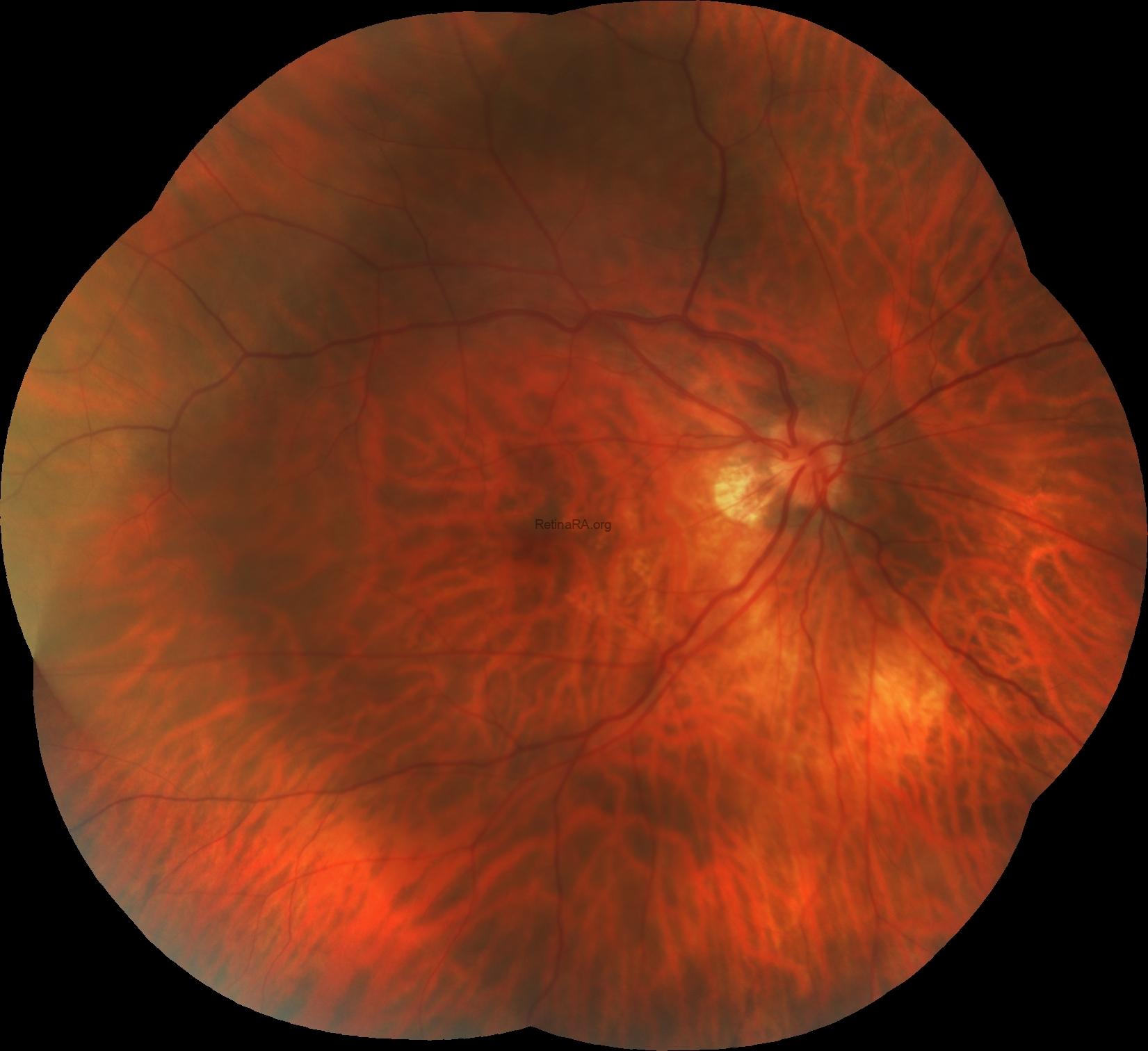

Optical coherence tomography with infrared and multicolor demonstrated posterior staphyloma, subretinal hyperreflective material and minimal adjacent subretinal fluid in the right eye. The underlying choroid was markedly thinned, consistent with pathological myopic changes in both eyes.
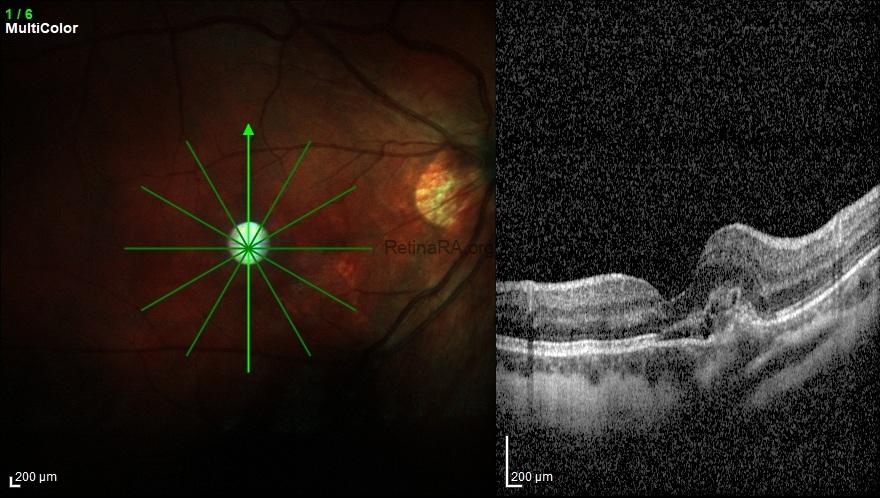


Optical coherence tomography angiography (OCTA) revealed a distinct, compact neovascular network within the outer retinal/avascular slab, corresponding to the subretinal hyperreflective lesion on structural OCT. Cross-sectional OCTA with flow overlay demonstrated flow signals within the neovascular tissue, confirming the presence of an active vascular complex.


Myopic macular neovascularization (mMNV), traditionally referred to as myopic choroidal neovascularization (mCNV), is a vision-threatening complication of pathological myopia and an important cause of central visual impairment in young and middle-aged adults.
Myopic MNV typically develops in association with mechanical stress and disruption of the RPE–Bruch’s membrane–choriocapillaris complex, frequently at sites of lacquer cracks. Unlike neovascular age-related macular degeneration, myopic MNV usually presents as a relatively small, predominantly type 2 neovascular complex, often associated with limited exudation despite clinically significant visual symptoms.
Intravitreal anti-vascular endothelial growth factor therapy is the first-line treatment for active myopic MNV, often requiring fewer injections than neovascular age-related macular degeneration. Nevertheless, long-term follow-up is essential due to the risk of recurrence and progressive macular atrophy, which may compromise visual outcomes.
Credit: Kemal Tekin, M.D., FEBOS-R, from Ulucanlar Eye Training and Research Hospital
Instagram accounts: @retina.academy and @dr.kemaltekin
